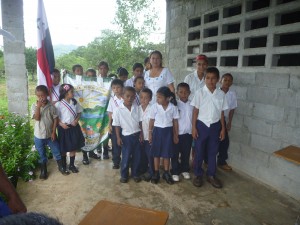
Mamoni Arriba was celebrating national holidays on November 3rd, which is the day when Panama separated from Colombia. The teacher, Denia Espinoza, organized a wonderful event where all the students got the opportunity to share poems and songs with their families and neighbors.
The only school located in Mamoni Arriba has 21 students that range from 1st to 6th grade. The teacher teaches all the different levels at the same time within the same classroom. If students want to attend Junior High they have to move from Mamoni Arriba.
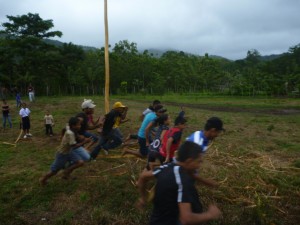
The games started following the students performance. One traditional game that is commonly played during the national holidays is the “palo encebado”. This game requires a long tree stem. The bark from the stem is removed and then bathed in oil, water with soap, or some substance that makes it slippery. The stem is placed vertically attached to the ground and at the top of the stick is the price. To get to the price team members have to climb up the stem, by climbing over each other. The team that reaches the price first, wins!
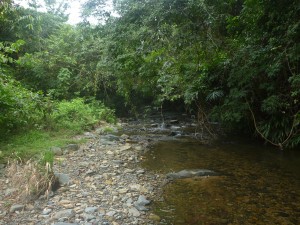
On one of my visits to Mamoni Arriba, I met a woman named Siomara that is probably in her early 30’s. She asked me: “why is the volume of water in the Mamoni River less now then it was when I was a little girl?” Well, of course I did not know that the volume of the river was less now than before. This was only my second visit to Mamoni Arriba and I hadn’t learned much about the river. The first thing that occurred to me was the rain. I thought, “well, maybe it is raining less now than it did before”, but some of the local people seemed to disagree. Most people I know haven’t perceived any changes in the rainfall pattern. They did however, agree that the water volume of the Mamoni River is less now than twenty years ago. Although the rain subject should be investigated a little bit further, I started thinking about other alternatives for why this must be.
The Mamoni River
It occurred to me that I should focus of things that have changed in Mamoni Arriba. Well, it might be directly related to deforestation. As ecoReserve continues exploring the Mamoni Arriba area, it will be interesting to understand the historical and temporal patterns of deforestation and what drove them. Today, the most common land use practice in Mamoni Arriba is cattle ranching. Most ranchers from Mamoni Arriba that are my age (between 25-35 years old), belong to the second generation of immigrants that moved from the southern part of Panama into Mamoni Arriba. Once they arrived, they clear cut the land and burned it. Later, they planted exotic grass species to feed the cattle. I have to point out that this is an oversimplification of the immigration process but, in general terms this is what drove deforestation. One family in Mamoni Arriba today can have up to 140 cows. Each cow requires 1 hectare of land to graze. I don’t know how much the landscape has changed in the past twenty years, but my guess is that it has changed a lot.
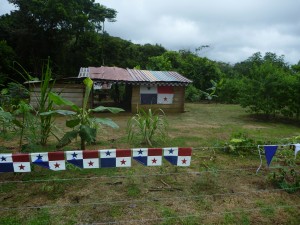
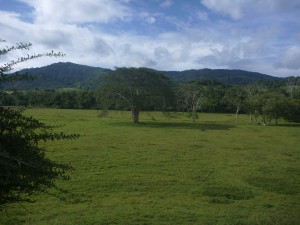
Typical view outside the Mamoni Arriba reserve
The fact is that without trees, water can’t be storaged on the ground. Consequently, the water springs that typically form inside the forest are lost. I have been able to find many water springs during my hikes. I suspect we could find hundreds of them that eventually flow into streams that end up in the Mamoni River. One tree in the forest is so much more than a trunk with leaves. It is a living organism that storage water on the ground by providing space between its roots and the soil; its leaves provide shade that contains the humidity on the ground. In addition, when the ground water encounters a rock, it is forced out and filtered by the soil so that it is released unto the surface clean and sweet. When trees are lost, all of its effects go with them and the ground becomes dry.
I think Siomara’s question is interesting and we should look more into it. Either way, one of the most immediate impacts of ecoReserve in Mamoni Arriba is that we are protecting a significant number of water springs and streams that are used by the local people. To me, one of the most fascinating events during my visits was when I drank water directly from a stream. This simple act is something that I hope future generations will still be able to enjoy.
I will tease you with some anecdotes so that eventually you will have to come to Mamoni Arriba to make your own stories!
The man standing to the left of the Corotu tree (Enterolobium cyclocarpum) is of course, Arsenio. This photo was taken on Arsenio’s farm. The Corotu is a massive tree that farmers allow to grow on their farms because cattle love to eat its fruits. I particularly love to find this tree in the forest because like many legumes, it has tiny leaflets that allow sparks of sunlight to penetrate through the forest canopy.
On the photo below are some of Arsenio’s cows. It might seem odd that I am posting photos of cows on a website dedicated to forest conservation, but cows are an important part of the culture in Mamoni Arriba. Many people in the area are in the cattle business. They rear the calves and sell the cows in Chepo which is a town 2 hours from Mamoni Arriba.
The women in Mamoni Arriba make hats with fibers that are extracted from a local plant that is commonly known as Junco. This species grows along rivers like the Mamoni River. They collect the shoots from the Junco plant, dry it and extract the fiber to weave the hats.
For women it is very important to have a garden surrounding their houses. Florinda, Arsenio’s mom, has an extraordinary collection of orchids. Orchids are an epiphytic plant, which means that they live on top of other plants without hurting their host. Florinda also has terrestrial garden flowers including Hibiscus, Ixora, Roses, and Impatiens.
Before leaving, Arsenio offered some coconut water or “agua de pipa”. The coconut water is the clear liquid inside the young coconut fruit. It is sweet and refreshing. You must not be afraid of heights to collect the coconut fruit. You must also be skillful with the machete to remove the outer green husk.
I rode a horse for the first time in my life last Monday. I did not plan to go up the mountain on horseback, but as soon as I entered Mamoni Arriba I found Arsenio waiting for me with two horses. The name of my horse was Ardillo which in English means male squirrel. According to Arsenio, Ardillo looks like a white squirrel that he often sees in Mamoni Arriba. I don’t know if what he said was true but now I want to see that little squirrel. Arsenio told me to hop on the horse and I was very frightful. I asked him to give me a brief course on horseback riding so he said, “ride with confidence and a real horseback rider is the one that has fallen off a horse at least once.” I thought “Yikes!”
We started the trail where the Mamoni river meets the Espave stream. My goal was to make it to the lands of ecoReserve and to survey some of the plots for restoration. The trail was half an hour on horseback and half an hour by foot hiking on steep slopes. To reach the ecoReserve lands we had to cross several farms that are predominantly used for cattle ranching. Since it was early in the morning we stomped upon a herd of cows that were just returning from the milking parlor. I tried to count the number of cows but I stopped at twenty-five. There were many more.
Cattle’s ranching is the most common land use practice in the area of Mamoni Arriba. This land use practice has a high cultural value in many areas of the country. Cattle’s ranching is a problem because ecologically it is unsustainable since it requires direct forest clearing, introduction of exotic grasses for feeds, and deterioration of the soil. Ranching is not restricted to cattle since much of the pasture land in Mamoni Arriba is used to feed horses. Ranching is an unsustainable practice because farmers directly rely on expanding there land to increase the size of their herds. However, land is not infinite and eventually ranchers ran out of land and they go in debt among other issues. In ecoReserve we are working to restore some lands that have been directly impacted by cattle. We are also working on understanding the culture of Mamoni Arriba so that we can create alternatives to replace these forms of land use.
Arsenio and I made it to the ecoReserve land. Specifically, we made it to the spot where we want to start restoring. The spot was exactly on the ridge of the mountain. The view was amazing from this spot since it is surrounded by mountains fully covered with forest on one side and on the other side, the valley. The restoration spot gave me a lot to think about. I did my MS in restoration ecology so I was trying to bring together all the concepts I had used in the past to understand the terrain and the potential for its recovery. I became disturbed by the abundant grass “paja canalera” or wild sugar cane (Saccharum spontaneum). The “paja canalera” is a 3m tall exotic grass that was introduced by the Americans into Panama to control erosion along the Panama Canal watershed. As exotic species tend to do, it quickly became an invasive species that has spread all throughout the country. This grass is the enemy of all who try to use the land it has colonized including restoration ecologists and cattle ranchers. Yes, I was disturbed! Arsenio on the other hand was very calm.
We decided to start walking down our ridge to be restored, and into the Espave river when we heard a bird calling. The bird was a Chestnut-mandible toucan (Ramphasto swainsonii) or “Dios te dé” which means God give you. It was difficult to get close to it without scaring it away. At one point it flew straight into a Cecropia sp. tree and we got closer to it. Arsenio said to me that this was an important ridge for this particular bird species because they tend to stop here as they move from one side of the forest to another side of the forest. He also mentioned that the birds were very cautious when they passed through here because of all the dangers including predators and hunters. I thought then, “This is exactly why we should restore this ridge”.
We made it down to the Espave river where I got some waypoints with my GPS. The river was very cold and the water crystal clear. Arsenio found a spot along the river that was at least 3 m deep. It was outstanding! Arsenio directed me towards a place along the river with flat ground that we could potentially use to construct the nursery for restoration. Before I could make it, I was striken by the sight of a small frog that I had only seen in photos. When I saw this little frog I wanted to cry because it really was one of the most beautiful creatures I have ever seen. The frog is called a glass frog (Centrolene sp) because you can see their organs through their abdomen. I guess Arsenio realized I was not walking with him because he came back wondering what was wrong. I showed to him the frog and he helped me make a video. The sighting of the glass frog really made my day!
After finding the flat terrain along the river we began our hike back. For a while Arsenio was joking saying that he couldn’t find the horses. Finally, we found them and began a 2 hour horseback ride to meet his family. When I arrived they gave me a very warm welcome with delicious food. In the end, I did not fall down from the horse. I am not looking forward to becoming a real horseback rider.
En cuanto llegué a Mamoní Arriba encontré a Arsenio esperándome con dos caballos. No tenía planeado montarme en un caballo, pero me tocaba por primera vez en mi vida montar para poder llegar al filo de la montaña que vamos a restaurar. El nombre de mi caballo era Ardillo, según Arsenio porque se parece a una ardilla blanca que es muy común en el área. Le pedí a Arsenio que me diera un curso rápido de equitación, y él respondió con dos ideas “debes montar con seguridad y un verdadero jinete es el que se ha caído del caballo por lo menos una vez”. Por supuesto yo pensé “hoy no me quiero convertir en un verdadero jinete”.
Empezamos la cabalgata a la montaña por un camino que empieza donde el río Mamoní se une con la quebrada del Espavé. El objetivo de esta gira era llegar a las parcelas de ecoReserve. Antes de que llegara ecoReserve estas tierras habían sido utilizadas en su mayoría para el pastoreo de las vacas. Estas parcelas están en el filo de la montaña, y para llegar era necesario montar caballo por media hora sobre lomas empinadas y luego viajar media hora caminando. Debido a que comenzamos la caminata temprano en la mañana, nos topamos con una manada de vacas lecheras que iban saliendo de la sala de ordeñar. Intenté contar las cabezas de ganado pero cuando llegué a 25 me detuve.
El pastoreo es el uso de suelo más común dentro del área de Mamoní Arriba y tienen un gran valor cultural. Esta práctica es un problema ecológico en el área porque requiere de la tala del bosque. Una vez que se ha talado el bosque se introducen pastos exóticos para alimentar al ganado; el efecto de estos pastos sumado al impacto del ganado deteriora el suelo. El pastoreo no está restringido al ganado ya que gran cantidad de las tierras usadas en Mamoní Arriba son para alimentar a los caballos. El pastoreo es una práctica no sostenible desde el punto de vista ecológico y económico porque las tierras disponibles para potreros no son infinitas.
Arsenio y yo llegamos a las tierras de ecoReserve a la parcela donde queremos comenzar los proyectos de restauración. Esta parcela está sobre un filo que por un lado está rodeada de montañas cubiertas de bosque y por el otro lado se puede ver el valle de Mamoní. Yo hice mi maestría en ecología de restauración y estaba intentando reunir los diferentes conceptos que había estudiado para determinar el potencial que tenía el área para ser restaurada cuando observé la abundancia de la paja canalera (Saccharum spontaneum) sobre las laderas del filo. La paja canalera es un pasto de tres metros de alto que fue introducido por los estadounidenses para evitar la erosión del suelo a lo largo del Canal de Panamá. Hoy en día se ha convertido en una especie invasora que se encuentra a lo largo de todo el país y que es enemiga de cualquiera que desee utilizar las tierras que han invadido incluyendo los restauradores del bosque y los ganaderos.
It is easy to quickly recognize the beauty of the Mamoni landscape. Multiple hill tops spread across the landscape were visible from the road to Mamoni Arriba. The surprise I felt laid in the fact that these hills and mountains were fully covered with jungle and not cattle pastures. These days, mountain tops covered with jungle are rare sights in the Panamanian country side, but not in Mamoni. I felt proud and content to be part of this journey into the Mamoni Valley.
I parted from Panamá city early in the morning towards the North East into Mamoni Arriba. My objective was to meet the local people and understand the landscape so that I could plan a longer visit. Luckily for me, I was accompanied by Roland who was born in Mamoni and has been working for Earth Train for many years. I was also accompanied by Carlos Andrés who is a Panamanian lawyer that works for Earth Train and has spent valuable time working in the valley. I had been warned about the access road to Mamoni Arriba because during the rainy season it becomes difficult to ride. However, Rolando’s driving skills did the trick and got us to Mamoni Arriba in no time.
The landscape going down the road and into the Mamoni valley was truly amazing. The valley per say was mostly covered by pasture land. In the background I could see the mountains that surround the valley and that are shared with the Chagres National Park and the Comarca of Kuna Yala. The forest that lies on these mountains is what we in ecoReserve are working to protect. I was imagining myself crossing the mountains to Kuna Yala when Rolando decided to stop at “el filo”. El “filo” is the spot with the highest altitude on the road to Mamoni Arriba. Rolando showed me the Caribbean towards the North. I knew it was the Caribbean because I could clearly see the islands that are part of Kuna Yala. I’ve never visited these islands but now I can say that I’ve seen them from a distance.
Once we made it to Mamoni Arriba we met with Arsenio. Arsenio is a very funny man and with a lot of energy. I wanted him to take me to the forest, to a very “specific spot”! Since I had never been in the valley the only way I could explain to him where I wanted to go was by showing him an aerial photography of Mamoni Arriba. In somewhat of a silly manner he told me that, “he couldn’t understand the image because the highest altitude he had ever seen his house from was 14 meters”. I immediately thought to myself how I had felt the same way the first time I looked for my house on Google earth. I started laughing.
We spend quite sometime figuring out a way to reach the “specific spot” that I wanted to visit. We figured out our starting point for my next visit. The starting point will be where the Espavé stream connects with the Mamoní River. I met with many more people and got a very good feeling for the site.